 This is the moment where Buffy becomes a true hero. In the end, she sacrifices her one true love to save the world. It's something selfless, soul-destroying, and painful. But it's necessary. Following her destiny, she puts the world before herself. It's heartbreaking to watch her face as she reunites with Angel, only to realize the world is ending and that she has to do the inevitable deed to save the day. But, as the credits close and we join in with the Grr... Aargh! vamp at the end and ask for a hug, it's not just Angel she has lost. She's lost her home, her education, she's presumably still a murder suspect, she feels the weight of the world on her shoulders, she feels responsible for the attack on her friends. She's lost everything, and in her best 'homeless woman' pants, flees town. It's a devastating ending, one of the most poignant moments the show ever depicted.

Showing posts with label Buffy reviews: Season 2. Show all posts
Showing posts with label Buffy reviews: Season 2. Show all posts
Monday, July 11, 2011
Buffy: Becoming Part 2 (2.22)
This is the moment where Buffy becomes a true hero. In the end, she sacrifices her one true love to save the world. It's something selfless, soul-destroying, and painful. But it's necessary. Following her destiny, she puts the world before herself. It's heartbreaking to watch her face as she reunites with Angel, only to realize the world is ending and that she has to do the inevitable deed to save the day. But, as the credits close and we join in with the Grr... Aargh! vamp at the end and ask for a hug, it's not just Angel she has lost. She's lost her home, her education, she's presumably still a murder suspect, she feels the weight of the world on her shoulders, she feels responsible for the attack on her friends. She's lost everything, and in her best 'homeless woman' pants, flees town. It's a devastating ending, one of the most poignant moments the show ever depicted.
Labels:
Buffy,
Buffy reviews: Season 2


Buffy: Becoming Part 1 (2.21)
 The theme of season two has been 'growing up', forced to deal with adult circumstances whether you like it or not. Here, in part one of the finale, we see an elaborate contrast between the vacuous 1996 Buffy fumbling around trying to stake her first vampire, and the wounded 1998 Slayer who is faced off against her first love and loses her friends in the process. Like Buffy, we also see Angel's history played out in front of us. His journey from drunken, sleazy Irishman to murderous vampire to a homeless man crippled with regret and pain, and finally back to the murderous vampire once again. Watching this exploration of both character's histories is pretty darn epic, another indication that Buffy as a series is stepping into adult and somehow legitimate territory. Compare Becoming to one of the earlier season two episodes (or even Go Fish last week), and it's pretty astounding to see how far the show has come in so short an amount of time.
Labels:
Buffy,
Buffy reviews: Season 2
Buffy: Go Fish (2.20)
 Here we are in standalone city once again, a monster-of-the-week episode clumsily slotted in between an episode that pushed forward momentum, via the combining of various standalone and arc elements and a doozy of a cliffhanger, and the two-part finale. Go Fish suffers because it's not even a particularly strong standalone episode. There are some interesting moments, but too much of the humor is of the goofy variety, while the 'message' at the center of the world is a little too preachy for me. And, once again, we have Angelus relegated to one scene of unnecessary violence, presumably because they contractually needed to use David Boreanaz every week. This may have been an average monster episode if it were made in season one or at the start of season two, but at this point in time it just looks and feels dated.
Labels:
Buffy,
Buffy reviews: Season 2
Monday, July 4, 2011
Buffy: I Only Have Eyes for You (2.19)
 What opens as a traditional ghost story, full of poltergeists, visions and monsters, suddenly becomes a whole lot deeper, creatively tying in season two's Angelus arc and creating a character-driven episode that is still standalone in nature. It's a huge success. Watching season two again, the writers really struggle to utilize Angelus effectively outside of the major Angelus-driven episodes. Instead of simply not featuring him, he is written into indulgent cameos with little purpose. I Only Have Eyes for You is the only episode in late season two (besides the heavy-hitter arc hours of Innocence and Passion) to effectively use the character, and his inclusion is a masterpiece in characterization and horror.
Labels:
Buffy,
Buffy reviews: Season 2
Buffy: Killed by Death (2.18)
 I've written before about the annoying stop-start feel to season two's major arc, and as we inch closer to the finale it's even more noticeable. Killed by Death is filler material of the highest order, an episode that features little of the spark that make everyday Buffy hours so compelling. You always know you're watching a below-par Buffy episode when you could easily swap out so much of the action and dialogue with any other fantasy series from the same era. Dean Batali and Rob Des Hotel as writers always seem a little unsure of what tone they're reaching for, like they're out of their comfort zone (presumably sitcoms, judging by their IMDb pages) and pasting together a bunch of random horror movie elements. Meh.
Labels:
Buffy,
Buffy reviews: Season 2
Buffy: Passion (2.17)
 Things aren't fun anymore. That's the message from this episode. Before Passion, we had the "Angel's gone bad" arc, where we're shocked and intrigued by Angel's reversion back to his Angelus persona. Here, the story becomes far heavier than simply another big bad. Passion is incredibly disturbing because the series doesn't shy away from depicting Angelus as a complete monster who casually enjoys the torment and misery he is inflicting on others. Spike doesn't get it. Angelus could easily just murder Buffy and her friends at the drop of a hat, but there's no fun in that. What Angelus wants to do is break the Scoobies down piece by piece, tormenting them in increasingly personal ways until they just can't take it anymore. He's a monster, through and through.
Labels:
Buffy,
Buffy reviews: Season 2
Wednesday, June 22, 2011
Buffy: Bewitched, Bothered and Bewildered (2.16)
 There are always moments in high school where you wish you could just make something happen. Make somebody like you, make your tests go perfectly, make things a little easier for yourself on the social spectrum. Xander, the most obvious depiction on this show of 'ordinary' succumbs to that feeling here, using his supernatural connections to make Cordelia fall back in love with him. But because this is an awesome comedy episode, the spell immediately backfires. And it's a hoot.
Labels:
Buffy,
Buffy reviews: Season 2
Buffy: Phases (2.15)
 One of the most successful aspects to Phases is in how the episode itself takes on board the relaxed, dazed feel of Oz himself. I loved how both his conversation about Cousin Jordy and the final revelation that he's a werewolf were ridiculously casual. No other show could do something like that, but there's a knowing sensibility to Buffy the Vampire Slayer that makes it work. Equally systematic of this show is how Oz, introduced only a couple of episodes ago, already experiences his own character development. He's not just the reserved, quiet and observant guy anymore, he's the secret werewolf now, too.
Labels:
Buffy,
Buffy reviews: Season 2
Buffy: Innocence (2.14)
 The best way to describe this episode is 'gut-wrenching'. Joss Whedon writes pain like nobody else around, creating an hour filled with some of the most heartbreaking moments I've ever seen on television. Here, Buffy experiences what so many young people feel at various points in their teenage years: sudden betrayal. Somebody she loves and cares about is suddenly acting differently, treating her in as hurtful and cruel a manner as possible. She's also experiencing one of the worst nightmares of teenage love: abandonment straight after sex. Angelus' treatment of Buffy is horrible to watch, Sarah Michelle Gellar beautifully conveying how destroyed she feels as her entire lovelife crumbles to pieces out of nowhere. When she isn't crying, she looks like she's on the verge of tears. When she isn't collapsed on the ground, she looks like she's aching to physically fall apart.
Labels:
Buffy,
Buffy reviews: Season 2
Sunday, June 12, 2011
Buffy: Surprise (2.13)
 While the real awesomeness lies in the next episode, Surprise is a lot of fun on its own. In setting up Buffy losing her virginity, the show excellently depicts that teenage sense of lust and fear. Buffy and Angel are all over each other, the two of them having such raw passion that the inevitable is right around the corner. I also loved Buffy's determination to not say goodbye to him as he plans to leave town with the Judge's arm. They're infatuated with one another, and Buffy isn't prepared to let him go before they've even consummated their relationship.
Labels:
Buffy,
Buffy reviews: Season 2
Buffy: Bad Eggs (2.12)
 The main problem with this episode is that there is little separating it from any other fantasy series from the 1990's. Characters are brainwashed by monsters into worshiping monster's overlord-type thing, hero saves the day. There's very little else to the hour, not even a metaphorical depiction of what happens when trust is broken, or what happens when people begin to act differently. Also disappointing is the compete lack of any Invasion of the Body Snatchers-style paranoia. The egg critters appear, characters are suddenly revealed to be evil, and folks begin cracking open the ground beneath the high school. It's major filler material.
Labels:
Buffy,
Buffy reviews: Season 2
Buffy: Ted (2.11)
 I always thought Ted could have been a stronger episode if it hadn't turned out that Ted was a homicidal robot. The idea of a sinister new presence suddenly appearing from within Buffy's home life is a great one, the possibility of exploring the resentment between child and step-parent intriguing. And while the episode does explore that to an extent, there's an inherent goofiness to the whole thing which makes it kind of a failure. In general, I'm a fan of that thing in movies and television where only one character is aware of another character's insanity, while everybody else floats around none the wiser. There are a couple of great moments in this episode which depict this, with Buffy pretty darn horrified by Ted's casual aggression and threats toward her. But then the whole thing quickly dove-tails into ridiculousness.
Labels:
Buffy,
Buffy reviews: Season 2
Friday, June 3, 2011
Buffy: What's My Line? Part 2 (2.10)
 Buffy and Kendra have an almost sitcom-like relationship here, Kendra kind of arrogant and opinionated about Buffy's flaws, and Buffy aggressively catty with the new Slayer in town. Their scenes together are a lot of fun, Buffy's put-downs hilarious in their broadness (from 'John Wayne' to 'Pink Ranger'). I also loved her obvious jealousy over Kendra's instant bonding with Giles ('volume six a-ha-ha!'), Kendra being sort of the perfect example of an obedient Slayer. But, for all her plusses, Kendra lacks the heart or personality that Buffy is so proud of. And as has been made clear so often on this show, it's those differences that make Buffy such a strong and worthy opponent of evil.
Labels:
Buffy,
Buffy reviews: Season 2
Buffy: What's My Line? Part 1 (2.9)
 It's a little clumsy, I guess, but Buffy has a case of the sads because she feels as if she's permanently stuck in her role as the Slayer. And while her friends are learning about their potential careers and setting up at least an idea of the future, Buffy feels as if she can't. Her destiny has already been decided, and nothing that comes her way will ever be able to take precedence over her slaying duties. It's more than a little convenient that into this puddle of navel-gazing comes her exact destiny double: Keen-dra the Vamp-eer Slay-eer! But more on that in a bit. Buffy is still at that crossroads where she wants to keep her normal life as intact as possible, and whines about it constantly. The ice skating sequence is a perfect metaphor for her life. She's free, like a regular teenage girl, until a giant boogeyman appears and tries to kill her. After killing him, she makes out with a vampire. The girl's got problems.
Labels:
Buffy,
Buffy reviews: Season 2
Buffy: The Dark Age (2.8)
 This episode treads similar ground to Lie to Me, in that they're both about learning uncomfortable truths. While The Dark Age is very much Giles' episode, it's Buffy who experiences an emotional sucker punch in the process. Just like last week, she discovers that another person in her life is a killer. But while Angelus' madness was a symptom of his being a vampire, Giles' involvement in a death came about as a result of a bunch of dumb kids looking for kicks. This development continues a theme of Buffy and her friends growing into a harsher, more violent world; where even the ones you love and care about have dark histories or destructive flaws.
Labels:
Buffy,
Buffy reviews: Season 2
Tuesday, May 31, 2011
Buffy: Lie to Me (2.7)
 An important feeling that rattles through most of season two is the sense of ambiguity that the show repeatedly explores. Characters throughout the season exhibit multi-faceted qualities, a complexity that several of the characters amusingly make reference to themselves. Even as we enter season two, the days where things are simply black or white are long gone. We've entered the scary area of moral ambiguity, where decisions are made based not only on what is right or wrong, but are affected by the fact that real people are involved. Ford isn't a nice person. He's willing to sacrifice his best friend, he's willing to sacrifice the lives of dozens of deluded teenagers. But he isn't a villain. He's wounded by the cancer that is destroying his body, and in his desperation is prepared to do something abhorrent. Joss Whedon forces complexity on his leads, pushing Buffy into an unsure world where morals aren't as distinct and obvious as she once thought.
Labels:
Buffy,
Buffy reviews: Season 2
Buffy: Halloween (2.6)
 The idea of costumes and masks rattles through all of Halloween. Buffy is distracted by the idea that she isn't Angel's idea of an attractive woman. He's hundreds of years old, surely he's really into hoity-toity ball-gown ladies, not snarky, casually-dressed '90s women? So she puts on a mask in an attempt to rectify that. Similarly, Willow is so uncomfortable in her own skin that she quickly abandons her plan to wear a revealing outfit for Halloween, and instead dresses up in a ghost costume which covers her head-to-toe. Only when magic intervenes and she is forced to ditch her mask does she actually become the confident girl she's desperate to be.
Labels:
Buffy,
Buffy reviews: Season 2
Buffy: Reptile Boy (2.5)
 Buffy always managed to create vivid metaphors for teenage existence without being obnoxious or preachy. Looking back at the high school years, so many stories (even the major Angel story this year) rely on the idea of screwing up in some way and the consequences that follow. Of course, being this show, those consequences involve actual monsters and demons. The events depicted in Reptile Boy are quite clearly a metaphor for a girl getting in over her head with a sleazy older boy, potential date rape ensues, and before long the girl gets chained up and fed to a giant snake in the basement. This stuff happens, people!
Labels:
Buffy,
Buffy reviews: Season 2
Wednesday, May 18, 2011
Buffy: Inca Mummy Girl (2.4)
 The season five episode I Was Made to Love You features a robot girl who encounters most of the Scoobies. Part of what made that episode so funny was that everybody immediately assumed that she was a robot. They're not morons, she was clearly weird and oddly perfect, like she had been programmed. That all equals robot. I bring this up because Inca Mummy Girl seriously makes you want to bash the characters around the head repeatedly until they get a clue. So much of the hour consists of Buffy, Giles and the gang attempting to work out who's responsible for the mummy murders and how the mystical seal got broken, when it's so blindingly obvious that the mummy is the mysterious foreigner with knowledge of Incan relics who has recently come into their lives. Gah!
Labels:
Buffy,
Buffy reviews: Season 2
Buffy: School Hard (2.3)
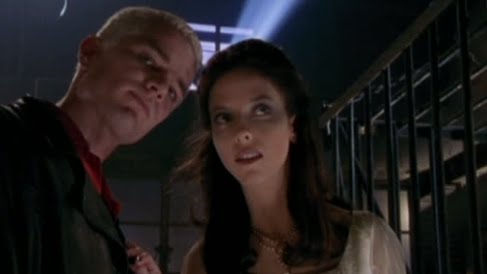 It's easy to forget how groundbreaking Spike and Drusilla were to Buffy. They are arguably the first antagonist characters who are just as funny and multi-faceted as the series regulars, an eccentric double act who bring a punky Bram Stoker quality to the show and an unprecedented feeling of black comedy. Spike is badass, ruthless and terrifying, but James Marsters instills in him a lovesick goofiness that makes the character so strong. I'm of the opinion that Spike was run into the ground as the series went on, so it's refreshing to see him being used so well in season two. Drusilla, as well, is a wonderful creation. She's entirely batshit, Juliet Landau flawlessly cast and being literally the only actress who can pull off Dru's nutty quivering and schizophrenic dialogue. They're both a hoot.
Labels:
Buffy,
Buffy reviews: Season 2
Subscribe to:
Posts (Atom)